Buying Acreage in Ferndale: Key Things to Consider
April 23, 2026
April 23, 2026
If you are thinking about buying acreage in Ferndale, it is easy to focus on the dream first: more space, privacy, room to build, and flexibility for the future. But with land, the details behind the listing often matter just as much as the number of acres. If you want to buy smart in west Pulaski County, you need to understand access, utilities, drainage, county rules, and what the parcel can realistically support. Let’s dive in.
Ferndale sits in Pulaski County’s west-side planning area, and recent rule changes make it especially important to verify how a property is governed today. In 2025, Pulaski County noted that Ferndale was part of the former Little Rock ETJ area, and Little Rock’s planning department said it would no longer provide planning, permitting, inspection, or land-use services outside city limits effective August 5, 2025, following Act 314. You can review that county update through Pulaski County news on the former ETJ area.
That shift means you should check current county rules instead of relying on older city maps or assumptions about oversight. Pulaski County also adopted a county-wide land use study and plan for unincorporated areas in May 2025, and county planning oversees development codes, road planning, floodplain rules, stormwater rules, and Lake Maumelle watershed regulations. You can see that framework in the countywide land use study announcement.
One of the biggest surprises with acreage is that owning land does not always mean you have simple, legal, usable access to it. Before you close, you should confirm whether the tract has road frontage, a recorded easement, or shared access that could affect future use.
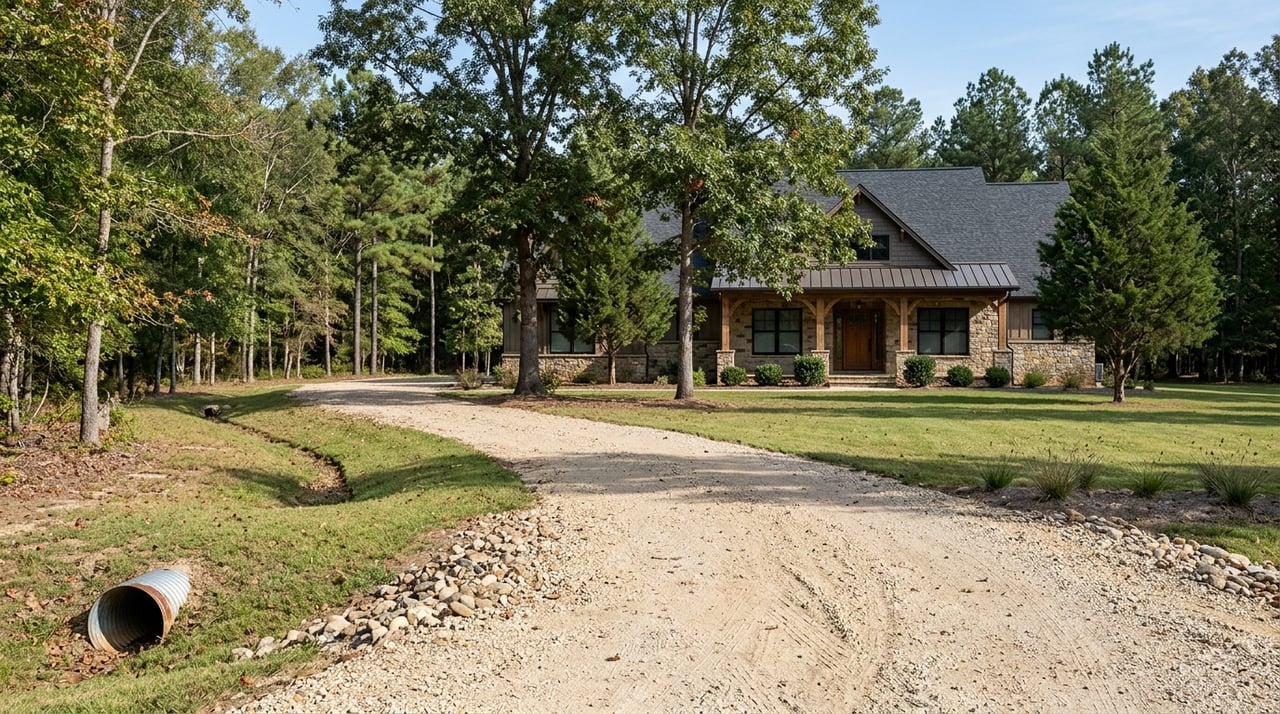
Pulaski County’s driveway permit application shows how specific this can get. The county states that no work may begin in the county right-of-way until an approved permit is received and posted on site, and the deed must be reviewed before work is scheduled. The form also notes a minimum 20-foot pipe length for driveway culverts.
These are not small details. If a tract is landlocked or needs costly driveway work, your total investment can look very different from the list price.
If you are buying acreage with plans to build a home, split the property later, or create a new lot, paperwork matters. Pulaski County uses formal review processes for subdivision and development activity in unincorporated areas.
According to the Pulaski County planning fees and schedules, the county has fees for preliminary and final plat reviews, minor subdivisions, and site-plan reviews. The county also uses a formal 911 addressing process, and utility companies must confirm an official 911 address before connecting services.
A buildable parcel usually needs more than open land on a survey. You want to know that the parcel has:
If any of those pieces are missing, your timeline and costs can change quickly.
Utilities on acreage are rarely one-size-fits-all. Two neighboring tracts can have very different service options, installation costs, and approval requirements.
The Arkansas Department of Health says construction plans should identify whether a project will use public sewer or septic and public water or private well. Its plan review guidance also states that county sanitarian approval is required when a project connects to septic and or a private well.
If a parcel may rely on a well, well placement rules matter too. The same state guidance says wells must be on well-drained sites, set a safe distance from contamination sources, and located at least 100 feet from septic tanks and similar sources, along with other protective standards.
Central Arkansas Water says its direct service boundaries include unincorporated Pulaski County, and a 2025 board packet noted that the West Pulaski Water Main Extension would expand service territory to the Ferndale and West Pulaski area. That is promising, but it does not mean every parcel is already connected or easy to serve. You can review the service-area context at Central Arkansas Water. Entergy also lists Pulaski County in its Arkansas service area.
Large parcels can feel peaceful and private, but day-to-day logistics still matter. Trash pickup, gated access, and long private driveways can affect how convenient the property feels once you actually live there.
Pulaski County’s sanitation and waste services page notes that sanitation service is available in the unincorporated area once set up, with pickup at the end of the driveway or street on private roads. That may sound minor during a showing, but it can be important when you are thinking through daily living on acreage.
In Ferndale, the shape of the land can be just as important as the size of the land. Slope, runoff, creek crossings, and low areas may affect where you can place a home, driveway, septic field, or outbuildings.
There is a USGS monitoring location on the Little Maumelle River at Ferndale, and Pulaski County says it administers floodplain, stormwater, and Lake Maumelle watershed rules while monitoring development in that area. You can explore the county’s broader review framework through Pulaski County Planning and Development.
A tract may look wide open and attractive online but still require significant site work. Before you assume the acreage is ready to build on, consider whether the property has enough usable area for:
Land that needs grading, erosion control, or drainage work may be more expensive to improve than expected.
Not all acreage listings should be judged the same way. Some properties are closer to a blank slate, while others already include meaningful site improvements.
According to Cornell Law School’s definition of unimproved land, unimproved land generally lacks development, significant buildings, structures, or site preparation. In practical terms, improved acreage is more likely to already have features like a driveway, utility infrastructure, or a usable structure, while raw land usually requires more upfront investigation.
If you are comparing raw acreage to improved property, your due diligence may look different. Raw land typically calls for deeper review of:
Improved acreage can remove some unknowns, but it can still come with title issues, easements, older systems, or site constraints. The key is to evaluate the parcel in its current condition, not just by its potential.
Before you move forward on land in Ferndale, it helps to use a clear checklist. Based on county and state guidance, here are some of the most important items to review before closing.
Acreage can be a great fit if you go in with clear expectations and strong local guidance. The goal is not just to buy land. It is to buy land that supports the way you actually want to use it.
If you are considering acreage in Ferndale or elsewhere around west Pulaski County, working with a local agent who understands the moving parts can help you ask the right questions before you commit. If you want experienced, one-on-one guidance as you evaluate land opportunities, connect with Kristen Honea Mccready.
Work with Kristen for a real estate experience defined by passion, innovation, and results. With the latest tools, market insights, and a client-first approach, she turns your goals into reality.
Keller Williams Realty
Kristen Honea McCready
(501) 960-5353
12814 Cantrell Rd Little Rock AR 72223